Saturday, March 23, 2019

Gubler Orchids

Funny how close things look on a map. When I was contemplating a trip out to Gubler Orchids, I didn't realize that I would have to drive 400 miles round trip!

Landers California, is an "unincorporated community" according to Wikipedia. It has long been reputed as a place where people get messages from extra-terrestrials. My initial impression of the place, is that it is ideal for folks who prefer their solitude, far away from any urban development. It was here that Hans Gubler moved his orchid growing operation from Los Angeles. Han's father, an immigrant from Switzerland, started selling orchids from the back of his station wagon. Han's children now run the operation. It makes my heart glad to see yet another example of  American entrepreneurism at work.

According to Chris Gubler, the desert sunlight is a major advantage to their growing operation. Even so, it was an overcast day when I arrived.


The retail sales area
Gubler supplies Lowes home center with orchid plants, and unlike other suppliers to the box stores, still labels its plants. This is mighty important to any serious orchid grower. An unlabeled or "lost label" plant cannot be used as a parent, nor entered into a judging with the American Orchid Society.
Several other visitors arrived during my stay there, including a very nice family from the San Francisco Bay area. We were part of the same tour group together through Gubler's greenhouses.


As we arrived in the first greenhouse, I noticed that the benches are arranged without walkways in between, thus maximizing growing space. Considering the booming wholesale business Gubler conducts, especially between Valentine's day and Easter, I appreciated the fact that they still allow visitors to their operation. They must employ staff just to keep the retail center open. Although I purchased a few plants for a modest fee, I didn't see that many retail sales while I was there.

Clearly, Lowe's is Gubler's retail space. They have instructional videos online for Lowe's employees to maximize retail appeal. My last visit to a Lowe's, I found a breathtaking display of color.

Gubler also hosts the Morengo Valley Orchid festival every October.


One question I got answered during my visit, was how they heat the place. They have no local piped in "gas service." The tourguide explained that they have a very large LPG tank onsite. The Phalaenopsis orchids shown here have very specific temperature requirements to induce flowering, especially in the winter months.
The desert gets quite cold, and I am sure Gubler's gas bill is a substantial part of its business costs.


Besides the heating costs, the greenhouses must be cooled during the desert's scorching summer temperatures. Gubler accomplishes this by the use of a "wet wall": a wall composed of excelsior cooler pads with recirculating water. The fans shown here are at the opposite end  of the greenhouse, and pull the humidified air through  the wet wall. The water recirculating system for the wet wall was something to behold in operation, even on a cool day.


In addition to heating and cooling, Gubler has developed induced flowering cycles to a fine art over the many years they have been growing. This is an example of their use of shading. The flowering cycles must coincide with peak retail demands; either too early or too late meaning possible loss of sales.


In addition to the many Phalaenopsis shown here, Gubler has some nice looking Cattleyas and Dendrobiums. They also specialize in Carnivorous plants, such as Nepenthes.
A visit to Gubler's is worth the trip. I also heartily recommend purchasing their plants at your nearest Lowe's.


Monday, March 18, 2019

The Santa Barbara Orchid Show

Early Sunday morning, I stepped aboard an Orange Belt bus to the Santa Barbara Orchid Show. According to Judy, the hostess that morning, their company started this excursion several years ago after I suggested it. This was my first trip on their line. Judy, a dear friend for many years, and Shelly the driver were a class act. I recommend Orange Belt Tours very highly.

We arrived at the Earl Warren Showgrounds on a very warm day. Bypassing the crowded parking lot, we were admitted to the show from a rear entrance just steps away from the main exhibit hall.


A unique local vehicle


I LOVE the new mini Reedstem Epidendrum hybrids


Norman's Orchids of Montclair, California won a prize for his display


This Bulbophyllum Phaelenopsis is an orchid grown for it's foliage as much as it's flowers.


Sunset Valley Orchids and their award-winning display.


As usual, no photo can capture the real thing adequately. Fragrance also wafted through the main exhibit hall.

One of the benefits of serious Orchid shows are the lectures and classes one may attend.


I know people who spend days at these events. I am  personally spent after a few hours. The colors and fragrances can overwhelm the senses.
After seeing the displays, I visited the plant sales area, where I renewed old acquaintances with Steve from Floralia Orchids of Brazil, and Sheldon from Carmela Orchids of Hilo, Hawaii. I also met the staff of Sunset Valley Orchids and Andy's Orchids for the first time.
Naturally, I brought a few plants home. I was especially pleased to purchase two forms of Laelia Purpurata from Floralia. This species is the national flower of Brazil. 
Sunset Valley Orchids had some lovely miniature Cattleyas in wild colors. Hybridizers today are attempting crosses that produce abundant large flowers on small plants; mighty important in today's world of high energy costs associated with the greenhouse.
After lunch at the Santa Barbara Fish house, which I highly recommend, our group headed home.
The day was thoroughly enjoyable. I plan to make it a yearly event on the bus from now on.


Saturday, January 5, 2019

The Temple and the Feast of Tabernacles

In addition to growing plants, the Temple functions as a small chapel. The theological symbolism that now exists there has taken on a life of its own.

To be more precise, this structure is more a "Tabernacle" than a "Temple," although the spiritual sacrifices offered there make it Temple- like.

After I built this building, I discovered more details about the Old Testament Feast of Tabernacles or Sukkot. The appearance of my greenhouse to the Sukka built by modern-day observant Jews during October was quite surprising.
 
 
Sukka roofs during the Feast of Tabernacles
 
A Sukka in someone's backyard
 
 
When I built my Temple, I made it from 4' x 8' panels that are bolted together. No panel weighs more than 25 pounds. The "temporary" nature of this structure ties into the ancient Jewish people, who until the Nation of Israel was established,  were repeatedly exiled all around the world. A difference between my version of a sukka and the authentic ones,  is that in the Temple the required foliage is inside.
 
As a Catholic, I belong to a the New Covenant form of Judaism. In fact, Jewish converts to Catholicism have told of their surprise that the Mass initially seemed like a Synagogue with Christ. The discovery of this Jewish feast is one of the fun moments when the Jewish foundation of our Church jumps out at me.
 
 
Typology at the Temple
 
 
An Old Testament "type" is a person, place or event that points to an event in the New Testament. Theologians have taught that the New Testament is concealed in the Old Testament, and the Old Testament is revealed in the New.
 
The statue of the Blessed Mother is turned in deference towards the Sacred Heart of Jesus statue.
 
 
The symbolism portrayed by these statues reminds one of the very beginning. Adam and Eve in the Garden of Eden. This was the First Adam and the First Eve. Our first parents fell from grace, having been deceived by the Devil. They were then banished from the Garden.
 
The "Last Adam" is the Lord Jesus Christ. ((I Corinthians 15:45). He began his suffering alone in the Garden of Gethsemane  (Matthew 26:36-56), which opened the way for us sinners to re-enter the Garden and eat the fruit of the Tree of Life.
 
His Mother is portrayed in Catholicism as the "Second Eve" or "Last Eve." Although abundant scriptural texts exist supporting this belief, it was  a later development of doctrine, well articulated by Cardinal John Henry Newman.
 
I spend many hours today enjoying my "Temple" with images of the "Last Adam" and the "Last Eve" in the garden.


Saturday, November 24, 2018

Norman's Orchids

Type Orchids.com in your browser, and you will go to Norman's Orchids in Montclair, California.
 
Norman Fang started his nursery in 1986, after graduating from Cal Poly Pomona with a degree in Ornamental Horticulture. The nursery is located in a residential area on what used to be Black Walnut orchards. They have a delightful retail location; one of the lone survivors of evolving market trends in the orchid world and in California. They have outlasted some huge orchid nurseries, in business just a few years ago,  that have either relocated away from California or gone out of business.

Norman had the foresight to obtain his website domain name early in the history of e-commerce. His company sells orchids all over the world. 
 
In addition to their e-commerce business, they still participate in many of the important orchid shows during the year. In fact, Norman shared with me that he had just returned from a show in Taiwan. He is also scheduled as a vendor in the upcoming Santa Barbara International Orchid Show this coming March, 2019.
 
I visited this nursery on November 23, 2018. To get there, I took a circuitous route to avoid Los Angeles traffic on the Thanksgiving weekend. 


I got to enjoy the "beauty" of the desert!
 
One iconic place I passed was Charlie Brown's in Little Rock, California. In my haste to get to the nursery, I didn't stop there. I am sorry I didn't. My family and I last visited there in the mid 80s. This is a "must do" for a future trip.


The Mormon Rocks near the transition between highways 138 and 15.
 
 
On a very overcast day, I arrived at Norman's around noon.


The entryway to Norman's Orchids


Specimens of Platycerium and other tropical plants grace the entryway.
 
Retail sales area


The second greenhouse literally took my breath away. Even on a sunny day, pictures cannot do these scenes justice. Norman uses temperature controls to induce Phalaenopsis to bloom year round for the market.


Norman's has many other genera represented in the retail area, many of them fragrant.


My Haul
 
I came home with several plants from Norman's. One orchid I was seeking was the Mexican species Chysis Limminghei, shown on Norman's website. I have grown Chysis Brachtescens, another Mexican species successfully for many years. C. Limminghei is harder to find. I have never seen it at any other nursery.


A surprise find was the fragrant Mexican species Encyclia Radiata.  I had been ambivalent about this orchid until I found a robust example of this plant at Norman's. When divided, it will make two respectable divisions and some back bulbs.
 
 
I love to grow Dendrobiums. They are upright growing, require little bench space,  tolerate the Bakersfield heat and reward a little culture with flowers that last all summer. I found this Dendrobium Hsinying Frosty Maree ,which will join my growing collection. 
 
 
Finally, a little orchid kept calling my name. I tried to ignore her, because she obviously had a lot of Sophrinitis Coccinea in her background. Coccinea is a notoriously touchy grower, being especially sensitive to water quality.  Finally she said, "Daddy take me home!!!"


This is Sopholaeliocattleya Little Hazel. Her parents are tried and true old parents from the 70s and 80s. One of her grandparents is Slc. Jewel Box, an iconic hybrid. This little miniature will take up little greenhouse space and reward me with multiple flowers almost 3" across.
 
 
I enjoyed my trip to Norman's Orchids very much. Many thanks to Norman and his helpful staff!


Monday, October 22, 2018

New Phalaenopsis Strategy

 
The Phalaenopsis have been responding positively to their environment, growing large pendulous leaves. Growing them on a bench is proving to be problematic. They need more space, both laterally and underneath.
 
 
I found the perfect materials to construct this Phalaenopsis "ladder" at Lowe's home center. This is pre-primed pine. The primer looks perfectly fine, and no repainting was necessary.
 
This arrangement most closely simulates the Epiphytic character of these plants in nature as they hang from the tree branches.
 
 
I found a use for some old coat hangers. I bent them around a pot, then drilled two holes in the ladder. This is recycling unused material, and it is free!


The new coat hanger holders in use.


Saturday, September 8, 2018

The KeroSun Legacy

Bill Litwin, according to his LinkedIn page, has had several distinguished careers. He is a Navy veteran, flew for Pan Am airways, and has owned several companies.
 
In the seventies he traveled to Japan to negotiate becoming the U.S. distributor for a kerosene space heater, widely used in that country for many years. In the beginning, he sold this product out of his small hardware store in Connecticut until it grew into a $100 million dollar business. 
 
According to a New York Times article published in 1985, several unfortunate factors converged to bring about a swift demise to this prosperous company. Competitors began importing their brands, the winter was unusually warm that year, and Consumer Reports ran a review warning against the use of these heaters. They claimed that the heaters emitted dangerous fumes and were a fire hazard.
 
The parent company, Toyotomi of Japan, is still in business today and kerosene space heaters are still widely used in that country. According to a Japanese Heater safety website, electric space heaters have caused a higher number of injuries and deaths than kerosene ones.
 
How clean a heater burns depends directly upon good maintenance and clean fuel.
 
I bought one of these heaters in the early eighties and used it for several years in the early Temples. The orchid plants, highly sensitive to emissions and ethylene gas, thrived. I became a factory authorized serviceman for KeroSun, and sold and serviced these units at Greenacres True Value Hardware where I was employed at that time.
 
Recently, I found an Omni15 model on Ebay, and was pleased to acquire this heater very reasonably. This unit will provide some fine heat this winter in the Temple.


I found a wick badly in need of replacement, wiring that had become disconnected from the ignitor, and the need for a good cleaning.
The new wick is in place. Fortunately, parts for these heaters are readily available.
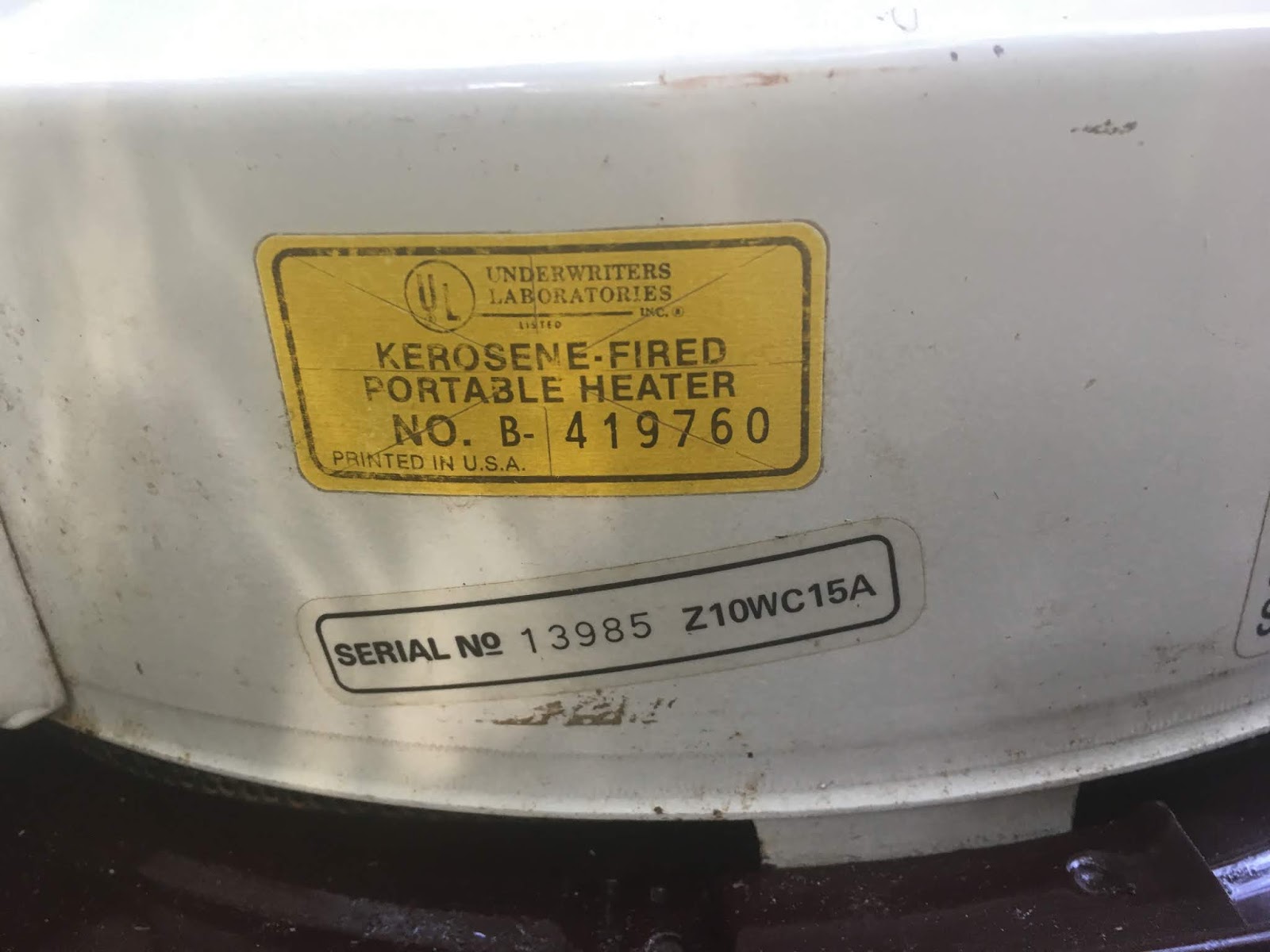
The heaters were able to obtain UL listings in spite of the claims of Consumer Reports.
Here is the finished product. I wrapped it and carefully put it away until the weather cools down.